Petlibro Scout Review: Is the AI Pet Camera Worth Its Yearly Plan?
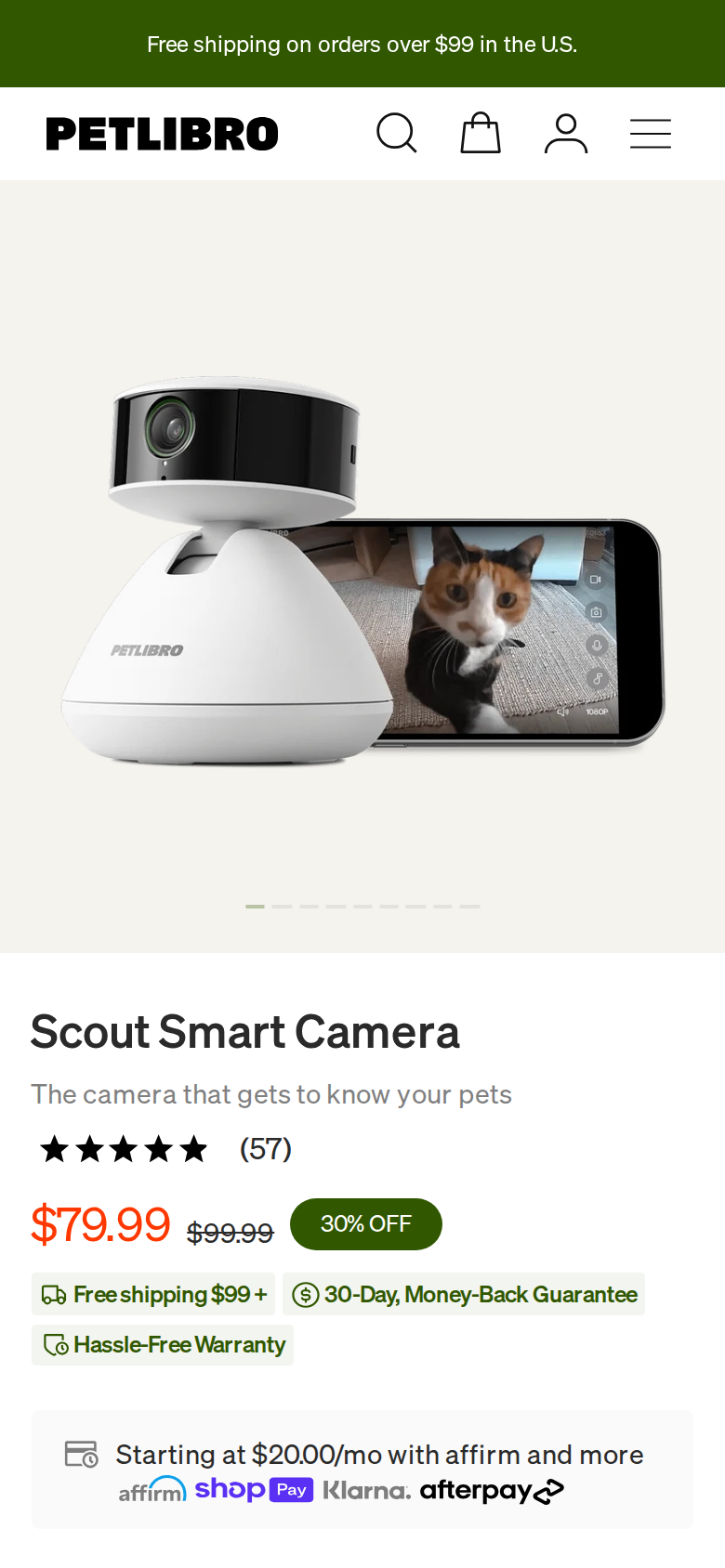
Petlibro's Scout is a $79.99 1080p pan-and-tilt camera that names up to five pets. Live view is free, but history and AI summaries need a plan from $95.99 a year, and independent testing found the recognition shaky.
Our verdict
The Scout is a fair $79.99 camera: 1080p, pan and tilt, two-way audio, dual-band Wi-Fi. The catch is that its main selling point, AI pet recognition and summaries, needs Video Cloud AI from $95.99 a year, and the one independent hands-on test we found says the AI mixes up pets. Buy it only for live view plus the plan, not as a feeder companion.
- Best for
- Petlibro households with one or two very different pets
Petlibro sells a feeder, a fountain and a litter box, and the Scout is the camera that wants to sit above all three. The pitch is neat: one app, one account, one family of devices. The real question is narrower. Is the Scout a good camera on its own, and is its AI worth a yearly bill that can cost more than the camera?
We built this review from Petlibro's product page, plan tables and FAQ, plus independent coverage from TechCrunch and Cats.com. Where a point comes from someone else's testing, we say so.
The camera is the cheap part
The Scout lists at $99.99 and was selling for $79.99 on Petlibro's own page when we checked. It is a small wired cube, 92 x 92 x 104 mm and 0.27 kg, powered by a 5V 2A adapter. The box includes a wall mount, an adhesive mount and screws, so it can sit on a shelf or go up high.
Video is 1080p with colour or black-and-white night vision, two-way audio and a pan-and-tilt head that can follow a pet automatically. It connects on 2.4 GHz and 5 GHz Wi-Fi, which matters: plenty of cheap cameras only accept 2.4 GHz and stutter at the far end of a house. A manual privacy cover slides over the lens.
It is strictly indoor. Petlibro says it is not waterproof, and it does not detect people or packages, so do not buy it as a door camera. There is also no SD card slot. Everything the camera records goes to the cloud, and that is where the money question starts.
Where the bill comes from
The camera works for live viewing without paying anything. Everything else sits behind Video Cloud AI. Petlibro's plan table shows three yearly tiers:
Standard: $95.99 a year, 7 days of video history.
Premium: $135.99 a year, 30 days of history, smart summaries and highlight reels, and free hardware replacement while the plan is active.
Premium Family: $159.99 a year, covering up to 3 devices (Scout cameras and Luma litter boxes).
The FAQ puts monthly billing at $9.99 and offers a 7-day free trial. TechCrunch, covering the launch in mid-2025, quoted $12 and $17 a month, so Petlibro has changed its pricing since. Check the live page before you buy. Each camera needs its own plan, so a two-camera home pays twice unless it picks the Family tier.
Run the numbers for the cheapest useful setup. A $79.99 camera plus the $95.99 Standard plan costs $175.98 in the first year. The camera alone is not the purchase. It is the entry ticket to a subscription, and that is how you should compare it.
What the AI actually does
The headline feature is pet recognition. The Scout can tell up to five cats and dogs apart and label each clip with a name. It reads out activities such as eating, drinking, litter box visits (cats only) and what Petlibro calls pet selfies, and it writes a one-line description of every clip. Premium adds a 30-second highlight reel of the day.
That is the maker's account, and it is flattering. Cats.com, one of the few independent hands-on reviews we found, reported that the AI often mixed up different cats or behaviours even after repeated corrections, and that it treated packaging with a cat on it, or soft furry material, as a pet. One test is a small sample, but it matches what Petlibro admits below. Petlibro itself warns that two near-identical pets, such as two black short-haired cats, are hard for the camera to separate.
Two more limits are in the maker's own FAQ. Auto-tracking adds motion that can lower recognition accuracy, so the two headline features work against each other. And the camera can hear sound but cannot tell a bark from a meow, so there is no noise alert yet.
Does it make sense next to a Petlibro feeder?
This was the angle we cared about. Petlibro's pitch is that Scout, a Granary feeder and a Dockstream fountain share an app. In practice the camera is not wired into the feeder: the FAQ describes feeder integration as a future plan, and TechCrunch noted the same at launch. What you get today is one login and one set of notifications, not a feeder that reacts to what the camera sees.
If you already own Petlibro gear, the shared app is a mild convenience. If you do not, nothing here ties you to the brand. A home that wants a camera first can pick on image quality and plan price alone.
The competition and the sharing rules
TechCrunch compared the Scout with Furbo's camera at about $210 with a roughly $7 monthly AI plan. That one adds bark detection and a treat tosser, so the Scout is cheaper to start but has fewer ways to interact. A bare Petcube Cam 360 costs far less still and needs no plan for live view, though it has no pet recognition.

Sharing is generous on paper: up to five family members or friends can watch live and view clips. They cannot control the pan, tilt or two-way audio, which is a sensible safeguard. No Alexa or Google Home support exists yet. Petlibro covers the camera with a 24-month warranty and a 30-day return window, and says the company uses video to improve its models, which some owners will want to weigh before pointing it at a bedroom.
Who should buy it, and who should not
Buy the Scout if you already live inside the Petlibro app, you have one or two clearly different-looking pets, and you value written summaries over scrubbing through footage. Accept that the real price is about $176 for year one.
Skip it if you only want to watch live, because a cheaper camera does that without a plan. Skip it for matching pets, for a door camera, or if you want bark alerts. At $79.99 the hardware is fair. At $175.98 for the first year it is an average pet camera with a promising feature that the one independent test we found says is still unreliable.
What we liked, and what we did not
Pros
- 1080p with colour night vision, auto-tracking pan and tilt, two-way audio
- Works on 2.4 GHz and 5 GHz Wi-Fi, with wall and adhesive mounts included
- Live viewing needs no plan, and a 24-month warranty plus 30-day return apply
- Names up to five pets and writes a short description of each clip
Cons
- Cloud only with no SD card, and history needs a plan from $95.99 a year
- Independent testing found the AI confusing cats and mistaking packaging for pets
- Cannot tell barking from meowing, and no Alexa or Google Home support
- Not wired into the Petlibro feeder yet, so there is no combined automation
Specifications
- Price
- $79.99 (listed $99.99)
- Video
- 1080p, colour and black-and-white night vision
- Movement
- Pan and tilt with automatic pet tracking
- Audio
- Two-way
- Wi-Fi
- 2.4 GHz and 5 GHz
- Size and weight
- 92 x 92 x 104 mm, 0.27 kg, wired power
- Storage
- Cloud only, SD cards not supported
- Standard plan
- $95.99 a year, 7 days of history
- Premium plan
- $135.99 a year, 30 days, highlight reels
- Premium Family
- $159.99 a year, up to 3 devices
- Warranty
- 24 months, 30-day return