Petlibro Granary Smart Feeder Review: Safe to Trust While You Travel?
At $89.99 the Petlibro Granary keeps feeding on its stored schedule when Wi-Fi drops. We check the specs, the support pages and independent tests for what could still go wrong.
Our verdict
A dependable dry-food feeder for one pet or two on the same diet. The schedule is stored on the unit, so a Wi-Fi outage costs you the app, not the meal. It has no camera, no pet recognition and no wet food support, and a jam still needs a human.
- Best for
- One pet on dry kibble, away for a weekend or a short trip
Nobody buys a feeder to admire it. You buy it so a cat or dog gets breakfast at 7 am while you are on a plane. So the only useful question about the Granary is what happens on the day something goes wrong: the router reboots, the power blips, a kibble wedges in the outlet.
We went through Petlibro's documentation, its support pages and independent reviews with that question in mind. The short answer is better than the price suggests.
The offline question, answered by the maker
The Granary is Wi-Fi controlled, and Wi-Fi at home fails often enough to matter. Petlibro's pre-sale FAQ says directly that the feeder still feeds as scheduled when it is offline but powered on. The app just cannot reach it until the connection returns.
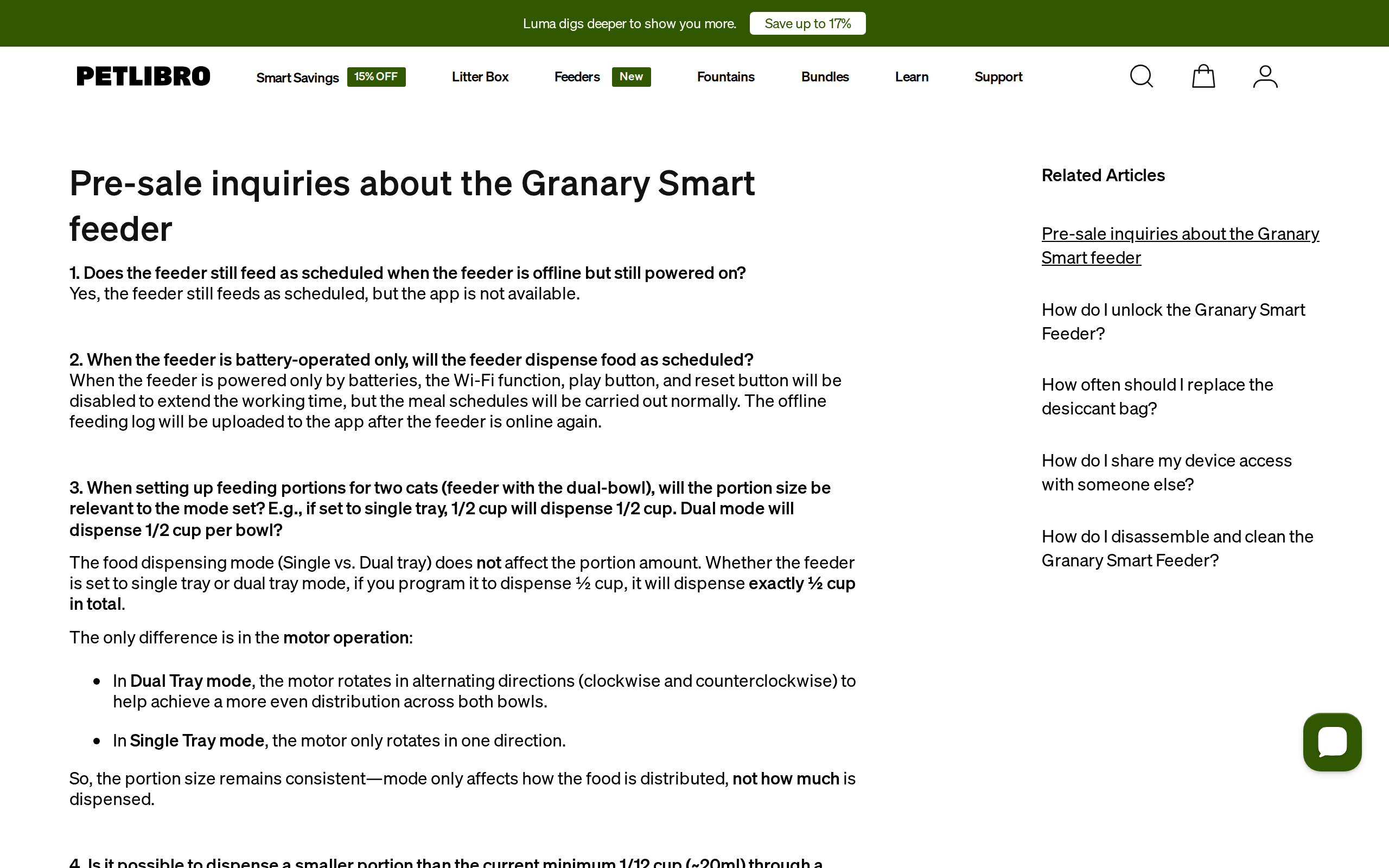
The same page covers batteries. The feeder takes three D cells as backup (not included), and on batteries it dispenses on schedule while the Wi-Fi function, the record button and the reset button are switched off. Missed feeding logs upload once it is back online.
That is the right design: the schedule lives on the feeder, and the app is a remote control. It also sets the limit. On batteries you lose Wi-Fi, so treat the cells as insurance for a power cut, not as a way to run the feeder cordless.
What it costs and what it holds
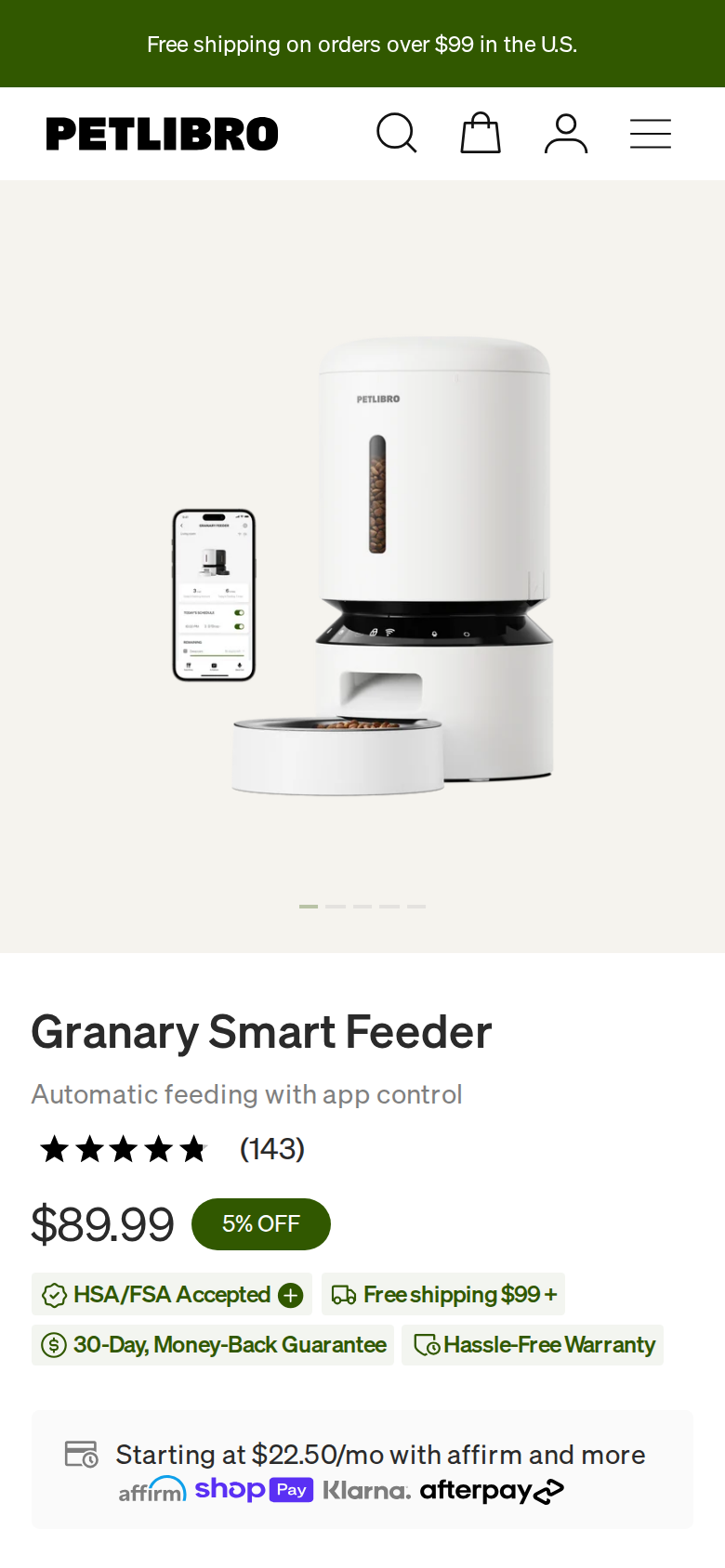
The price is $89.99, with a 24-month warranty and a 30-day money-back guarantee according to the product page. The hopper holds 5 litres of dry food. A portion is about 20 ml, roughly a twelfth of a cup, and you can set from 1 to 50 portions per meal, which is up to 4 cups, across 1 to 10 meals a day.
Other facts that decide whether it fits your pet:
Dry food only. Kibble must be 2 to 15 mm. Wet food, freeze-dried chunks and very large kibble are out.
Power. A DC 5V adapter, with the D-cell backup described above.
Wi-Fi. It lists both 5 GHz and 2.4 GHz support, which helps in crowded flats.
Freshness. Four seals on the hopper and a desiccant bag in the box. Petlibro recommends replacing the bag every two weeks.
Size. About 34 by 19 by 19 cm and 2 kg empty.
Bowl. A stainless steel bowl is included, in single or dual versions.
There is no camera. If you want to see your pet eat, you need a separate device. The Petlibro page lists optional Petlibro Care plans from $47.99 to $103.99 a year for wellness tracking, but the basic app, scheduling and notifications are free.
Portion accuracy and jams
Independent write-ups agree that it dispenses cleanly. A roundup from Cats.com, surfaced in our search, reports variance of about one portion with compatible round kibble, which is 20 ml. Treat that as a result for ordinary kibble and not a promise. Weigh a day's food the first time you set it up, and again whenever you change brands, because shape changes what a "portion" weighs.
Jams are the failure to plan for. Petlibro's design uses a wide outlet and alerts you in the app for low food, blockages, low battery and malfunctions. The app can tell you something is wrong, but it cannot unjam the feeder for you, and a jam at 7 am with nobody home means a skipped meal. That is a good reason to start the trip with a test run, and to keep a friend's phone number handy.
The problem Petlibro admits to
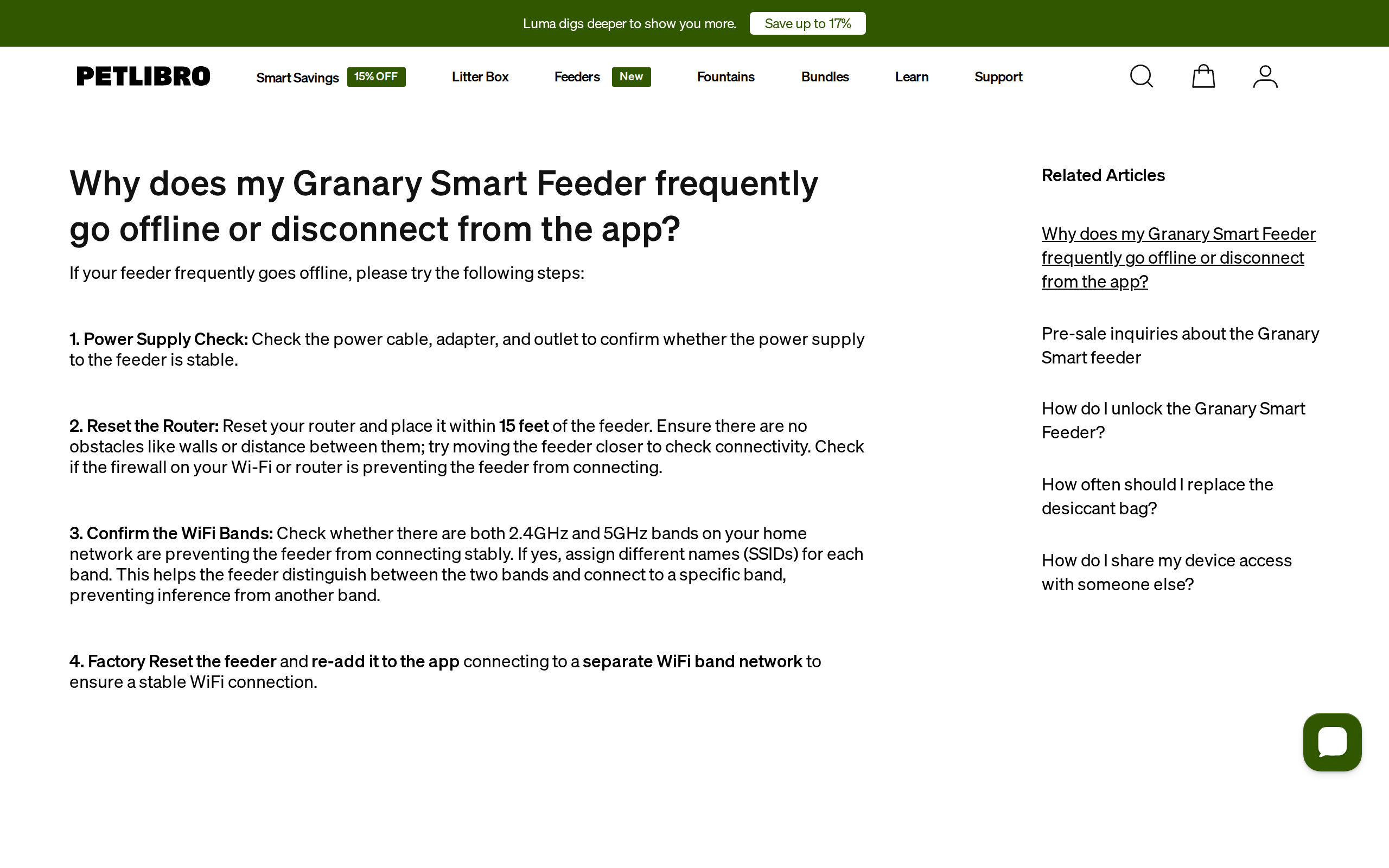
Connectivity complaints are the most common thing owners report, and Petlibro's own support page is candid about the causes: an unstable power supply, a weak signal, interference when 2.4 and 5 GHz share a network name, and a firewall blocking the device. It suggests resetting the router and placing the feeder within 15 feet of it.
Plenty of that is fixable. If your router uses one name for both bands, split them before pairing. If the feeder sits at the far end of the house, move it or add a mesh node. Because the schedule is stored locally, a dropout costs you remote control and notifications, not breakfast.
Who should buy it
Buy it for one pet, or two that eat the same food, if you want a cheap feeder with an honest schedule and an app that is mostly a convenience. At $89.99 it undercuts feeders that add a camera you may not use.
Look elsewhere if you feed wet food, if you need to feed two pets different diets (it has no pet recognition), or if you want a video check on every meal. And if your Wi-Fi is poor, fix that first, whatever feeder you pick.
We would trust it for a weekend. For a fortnight away, run it for a week at home first, fill the desiccant bag, and set up a second way to check on your pet. That caveat applies to every automatic feeder, and this one earns a good score for being plain about its limits.
What we liked, and what we did not
Pros
- Stored schedule keeps feeding when Wi-Fi or the app is down
- Dual-band 2.4 and 5 GHz Wi-Fi, 5 L hopper, up to 10 meals a day
- D-cell battery backup covers a power cut
- 24-month warranty and a 30-day money-back guarantee
Cons
- Dry kibble of 2 to 15 mm only, no wet food
- No camera, so you cannot check that the meal was eaten
- Wi-Fi and app control is off when running on batteries alone
- A jam is flagged by an alert but cannot be cleared remotely
Specifications
- Price
- $89.99
- Hopper
- 5 L, dry food only
- Portion size
- About 20 ml, 1 to 50 portions per meal
- Meals per day
- 1 to 10
- Kibble size
- 2 to 15 mm
- Power
- DC 5V adapter, 3 D cells as backup
- Wi-Fi
- 2.4 GHz and 5 GHz
- Size and weight
- 34 x 19 x 19 cm, 2 kg
- Warranty
- 24 months