HomeGPS Trackers & Virtual Fences
Garmin Alpha T 20 Review: Radio Tracking for Dogs Beyond Cell Towers
The Alpha T 20 costs $299.99 but needs a $800-odd Garmin handheld to work. We compare its 9 mile radio link and 68 hour battery with the cellular trackers.
Our verdict
For dogs that work beyond cell coverage, radio tracking is the right tool, and the T 20 is a slim, long-lasting collar for it. But $299.99 buys only the collar: you also need a Garmin handheld, which takes a bundle to about $1,100. For a dog that stays near home, a cellular tracker is cheaper and simpler.
- Best for
- Hunting and backcountry dogs working outside cell coverage
Cellular dog trackers answer the question "where is my dog?" as long as a phone tower can hear the collar. Garmin's Alpha T 20 answers it with a radio link that does not care about towers at all. That single difference decides who should read the rest of this review.
What $299.99 buys, and what it does not
The price on Garmin's page is $299.99 for the collar with its lithium-ion battery pack. It does not include a handheld. The collar transmits to a receiver, and Garmin lists the Alpha 10, 100, 200, 200i, 300, 300i, Astro 430 and PRO 550 Plus as compatible.
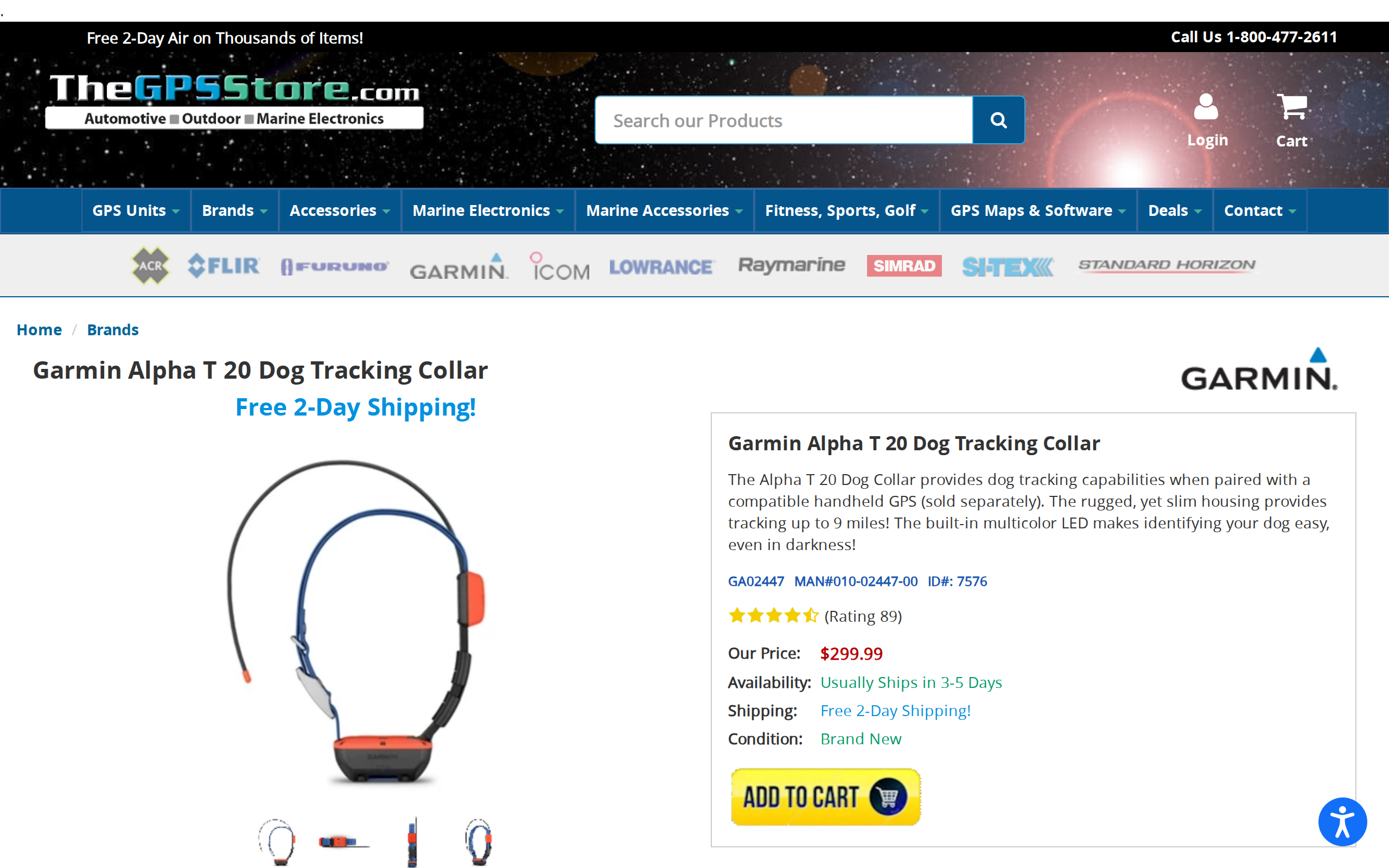
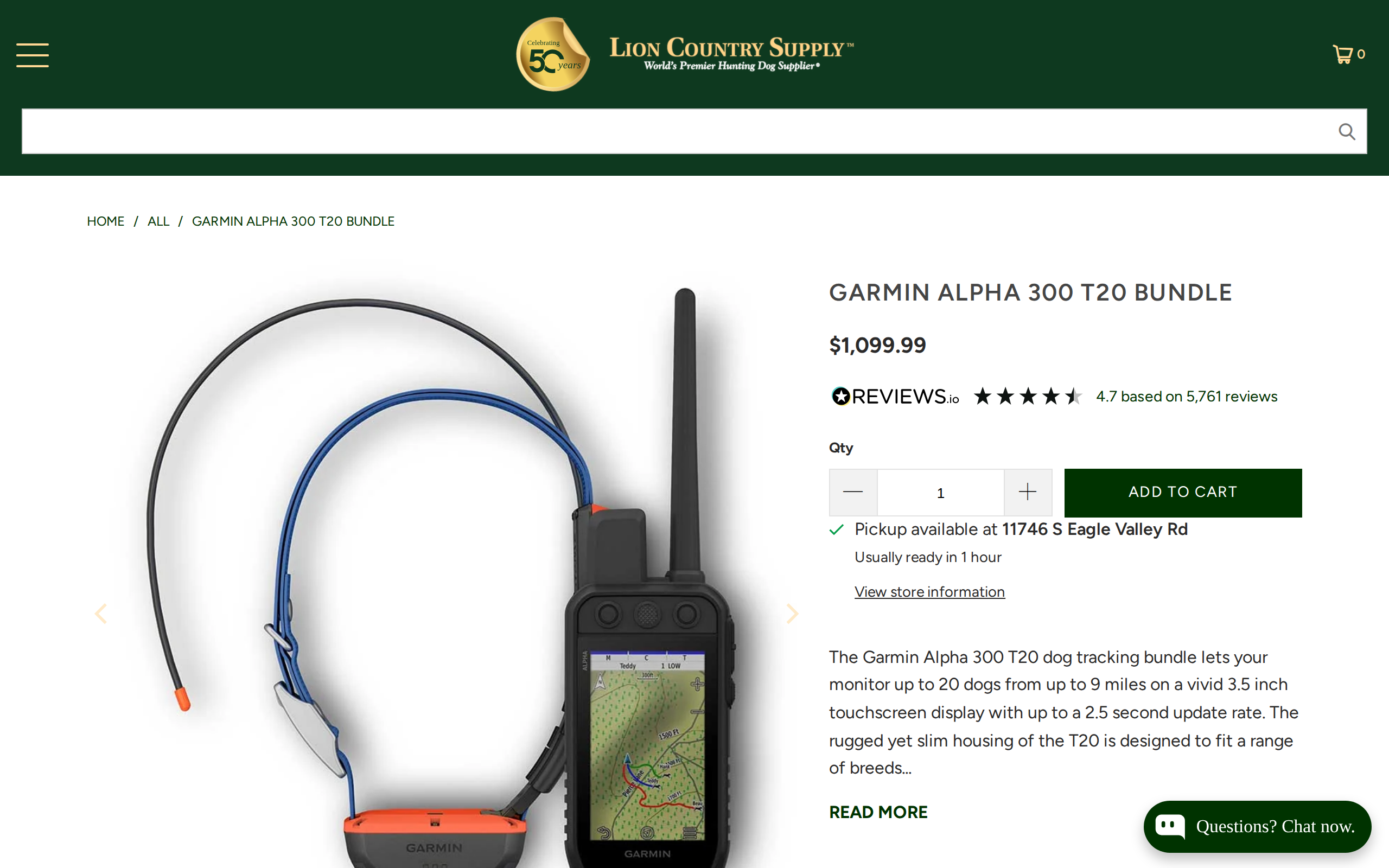
If you own an Alpha handheld already, the T 20 is a reasonable add-on. If you do not, the arithmetic changes. Lion Country Supply sells an Alpha 300 and T 20 bundle at $1,099.99, which implies roughly $800 for the handheld. That is the real entry price of this system.
Why radio beats cellular in the places that matter
Cellular trackers (we have reviewed several, including the Fi and Tractive models) depend on coverage and a monthly plan. In a canyon, a river bottom or a deep forest, there may be no signal, and the tracker has nothing to report through. The T 20 talks to your handheld directly, so the question is line of sight and terrain, not carrier maps. There is no monthly fee for tracking itself. The 300i handheld adds inReach satellite features, which carry a Garmin subscription, but the collar does not need it.
Garmin quotes up to 9 miles. Treat that as an open-ground ceiling. Hills and timber cut radio range, and the people who use these systems know it. The honest advice is to plan around a fraction of the headline number when your dog works dense cover.
Battery: where the numbers hold up
Battery claims are easy to inflate, so we wrote down the official table. The standard pack lasts up to 68 hours in the default dynamic mode, 25 hours at a 2.5 second update rate, and 84 hours at a 2 minute rate. The extended pack, sold separately, doubles the dynamic figure to 136 hours and reaches 168 hours at 2 minutes.
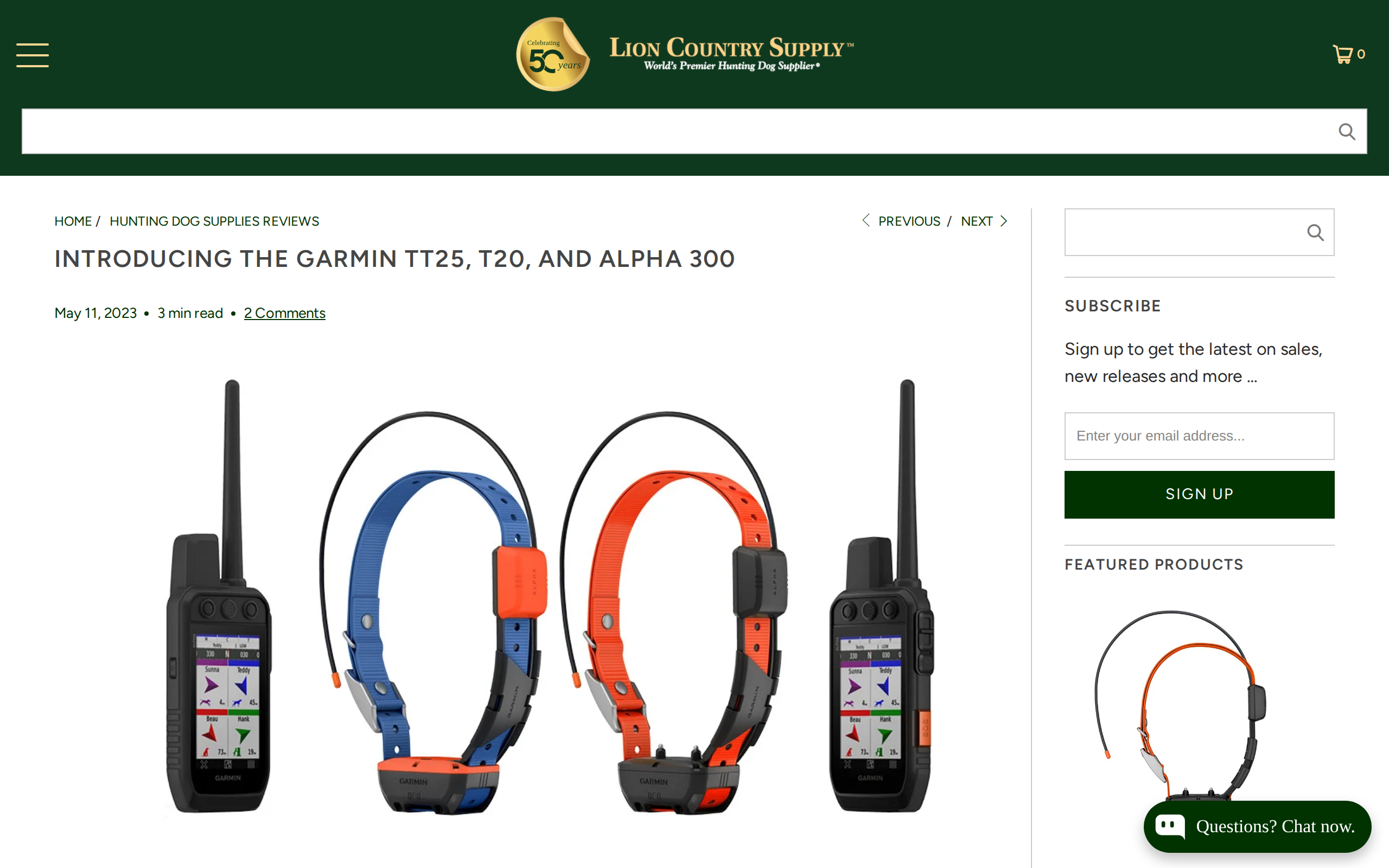
The catch is in the word "dynamic". The collar spaces out its position points when the dog is still, which is how it stretches a charge, and Gun Dog's launch coverage notes that the longer intervals can cost tracking precision. For a weekend hunt, a day on the trail or a long search, 68 hours is generous. For a dog you need to follow at jogging pace in real time, expect to run the 2.5 second mode and plan around 25 hours.
Fit, build and the antenna
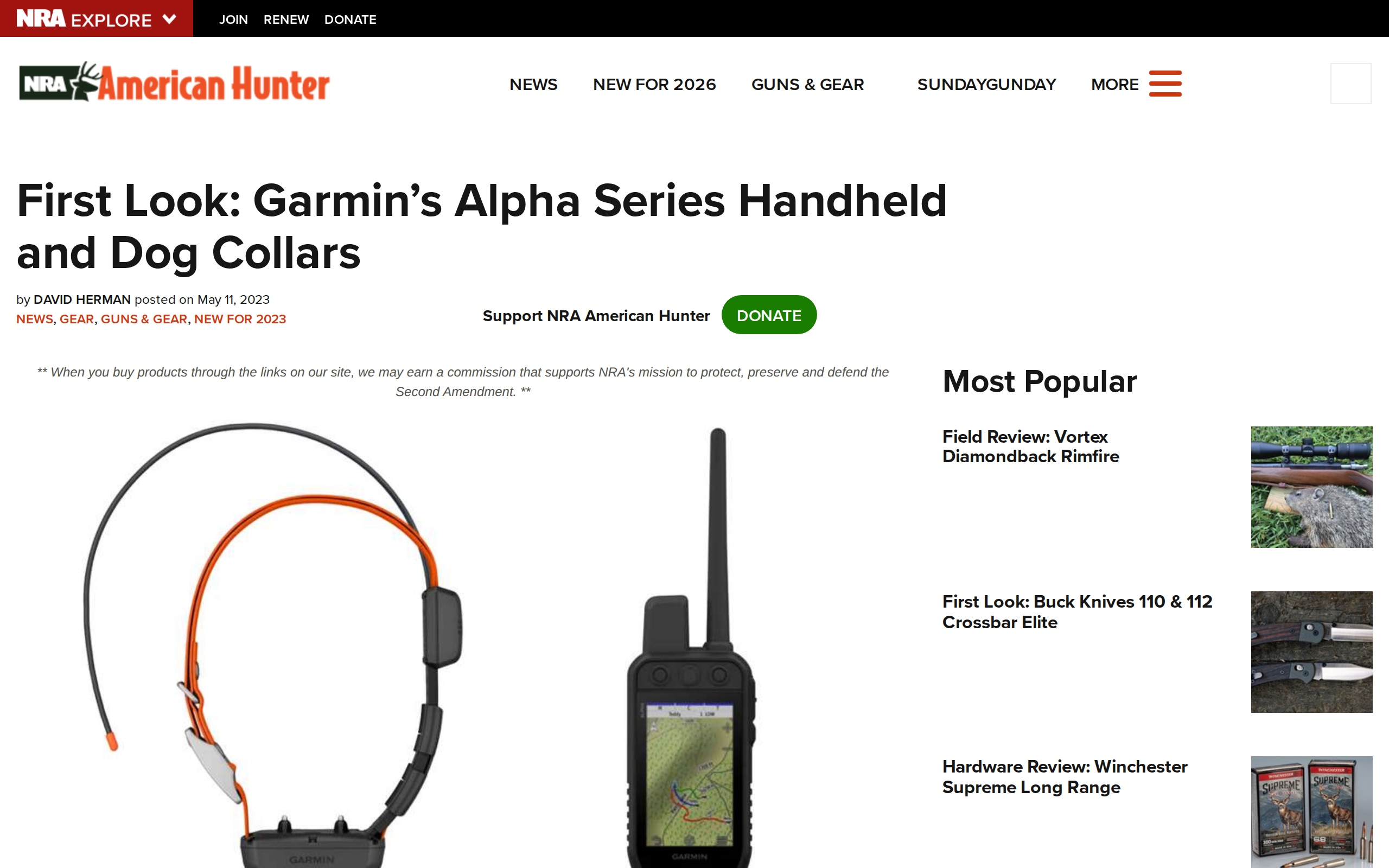
The unit weighs 5.9 oz without the strap and 8.4 oz with it, which is light for this category and still a lot for a small dog. It is rated IPX7, so it survives immersion, not a long swim at depth. The retailer's first look points to a replaceable GPS antenna strap, a useful change from older collars where a chewed antenna ended the collar's life. A multicolour LED helps you spot the dog at dusk.
Day-to-day upkeep is light. Garmin says the collar installs software updates by itself over Wi-Fi while it charges, so there is no cable-and-laptop ritual. One handheld can follow up to 20 dogs, which matters if you run a pack, though every extra dog means another $299.99 collar. Charging is the habit to build: a collar that dies in the truck is a very expensive strap.
Because it is tracking only, there is no training function. Garmin sells the TT 25 for that, at $349.99 according to the same retailer. If your dog needs correction work in the field, buy that one instead.
Who should buy it
Buy it if your dog works where cell coverage is poor or absent, you hunt for several days at a time, or you already own a compatible Garmin handheld. Skip it if you hike on mapped trails with good signal, want to check your dog from a phone, or are shopping for a collar under $300 in total. In those cases a cellular tracker costs less up front, even with its plan. We rate the T 20 well for what it is built to do, and we mark it down because the handheld you must carry turns a $300 collar into a $1,100 system.
What we liked, and what we did not
Pros
- Radio link works with no cell coverage and no monthly plan
- Quoted 68 hours on the standard pack in the default dynamic mode
- Pairs with Alpha 10, 100, 200, 300 and Astro handhelds you may own
- IPX7 rated body with a multicolour LED beacon for dusk and dark
- Replaceable antenna strap instead of a fragile built-in one
Cons
- $299.99 is the collar only, and the handheld pushes the total near $1,100
- The 9 mile figure is a best case, and terrain and tree cover shorten it
- Tracking-only: no training or stimulation, unlike the TT 25
- Dynamic mode spaces out position points to save battery
- No phone-only mode, so you carry a second device
Specifications
- Collar price
- $299.99 (collar and battery pack)
- Range
- Up to 9 miles (with a compatible handheld)
- Battery, standard pack
- 68 h dynamic, 25 h at 2.5 s, 84 h at 2 min
- Battery, extended pack
- 136 h dynamic, 50 h at 2.5 s, 168 h at 2 min
- Water rating
- IPX7
- Weight
- 5.9 oz unit, 8.4 oz with collar
- Compatible handhelds
- Alpha 10, 100, 200, 200i, 300, 300i, Astro 430, PRO 550 Plus
- Training features
- None (tracking only)